


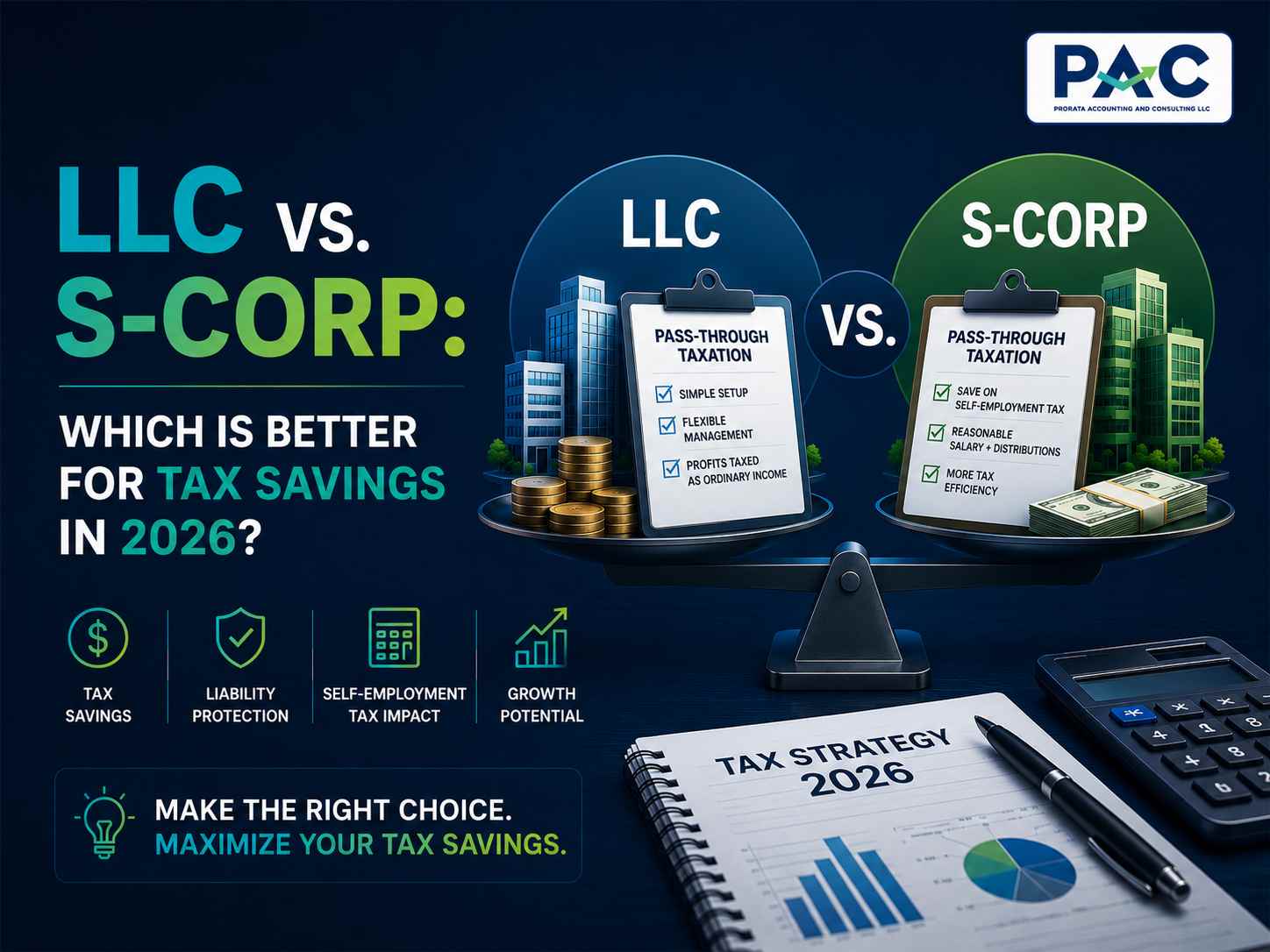
LLC vs. S-Corp: Which Is Better for Tax Savings in 2026?
-
Understanding an LLC
The advantages of an LLC include simplicity and flexibility in terms of tax reporting.
Key features include:
● Share through taxation of profit in business.
● Easy record-keeping and management needs.
● The benefit of a Limited Liability Company (LLC).Protection of business owners.
● No government-mandated owner payroll.
The typical tax regime would be for all net business income to flow through to the owner's individual tax return and be taxed at the self-employment tax rate. While an LLC isn't necessarily the vehicle for tax savings, S-Corp formation is one method that can help a business minimize taxes.
Why an S-Corp Can Save Taxes
Once a business is subject to an S-Corp election, the tax treatment of the business income changes.
Potential advantages include:
● Owners are paid a fair rate of pay.
● The normal share of remaining profits is retention (retained earnings)
● Generally, distributions do not have to pay self-employment tax.
● Work out ways to reduce the aggregate rate of payroll taxes for profitable businesses.
This arrangement means that the owner(s) can keep and control the salary while still receiving the distributions pass-through, thus landing them a great deal of tax savings.
Estimated Tax Savings in 2026
The businesses with the highest profits are often able to reap the benefits the most.
Approximate savings:
● Very small businesses with net income between $50,000 and $60,000 may start to see benefits from S Corp benefits.
● Net profit $75,000: Savings of approximately $2,948 (potential) in self-employment tax.
● $100,000 net income: Around $5,355 in potential savings.
● Around $10,485 per year in potential savings, excluding compliance costs: $150,000 net income.
The estimates highlight the importance for many growing businesses to make an S-Corp election once they have been profitable on a regular basis.
Additional Costs to Consider
Another thing about the S-Corp is that it adds administrative tasks.
Common requirements include:
● A look at how the owner can run the payroll
● Filing Form 1120-S
● Maintaining corporate records
● Making payments for payroll services, along with preparing taxes
They usually cost between $2000 and $4,500 a year, and may offset tax savings for less profitable companies.
Which Option Is Better?
It depends on the income from the business, its needs, or requirements.
Choose an LLC when:
● It's all about simplicity.
● Profits in the business sector are not very high.
● The cost of administration is preferable.
If you consider an S-Corp election, then you should understand:
● Net income consistently exceeds $50,000–$60,000.
● The benefits of making tax savings exceed the costs of complying with tax rules.
● The business can be the support of payroll and other filings.
LLC or S Corp: Final Decision!
LLCs offer several benefits beyond S Corps, and both could be eligible for the 20% Qualified Business Income deduction. An LLC is the simplest and most inexpensive structure for small businesses. For businesses with a fairly predictable flow of cash into and out of the corporation that make six figures or more, an S-Corp election may offer significant self-employment tax savings that outweigh the added expense of administering the corporation, making it a good option to consider for minimizing taxes in 2026.
Also Read: Common Bookkeeping Errors and Their Impact on Cash Flow