


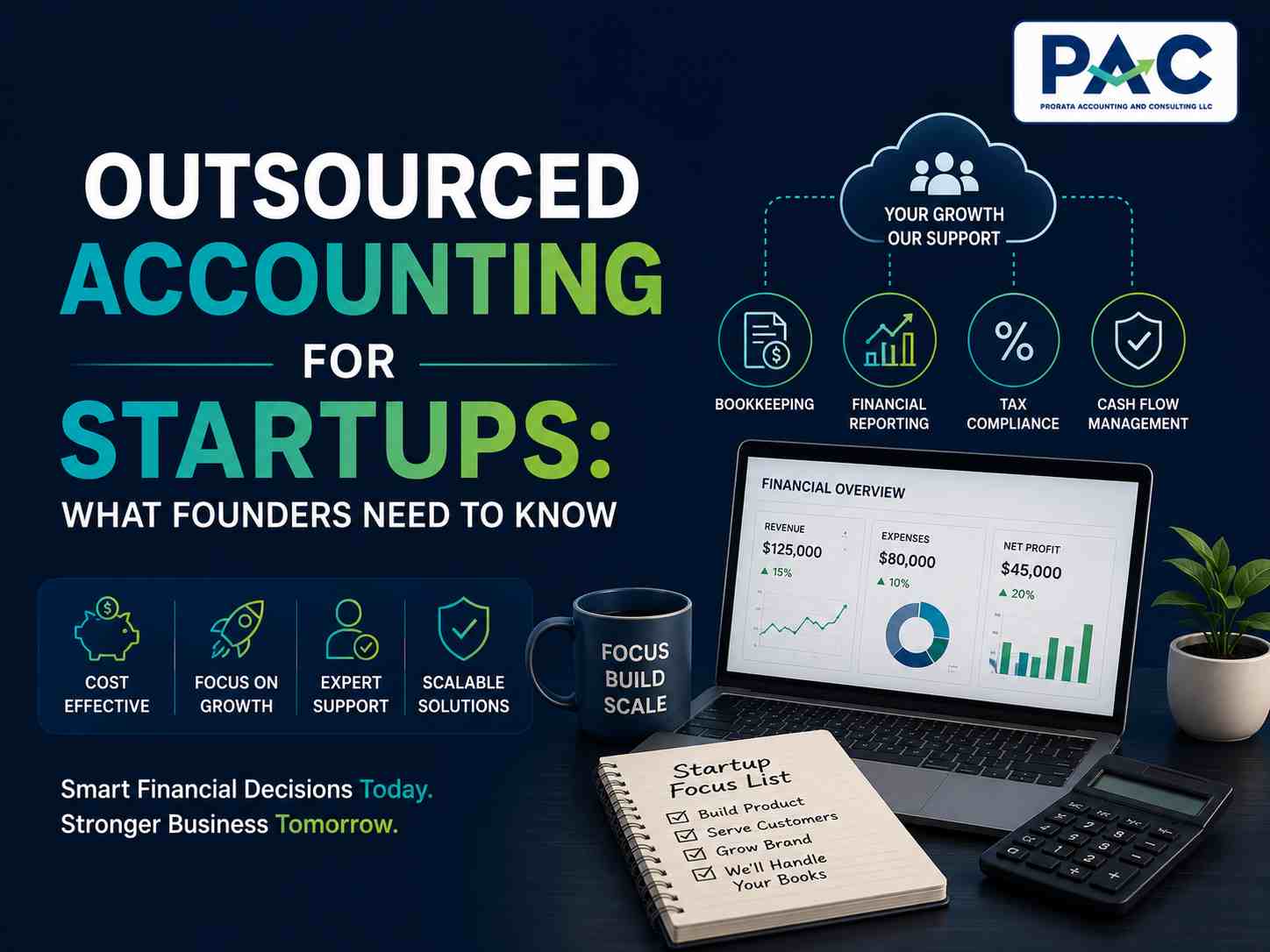
Outsourced Accounting for Startups: What Founders Need to Know
-
Roughly 90% of startups don't make it, and shaky financial management is one of the most common reasons why. A missed tax deadline, a cash flow report that doesn't add up, or messy books at the wrong moment can derail a company that otherwise had real momentum.
That's why so many founders now turn to outsourced accounting instead of building an internal finance function from day one. It's a way to get accurate bookkeeping, payroll, reporting, and compliance handled by professionals — without the overhead of a full in-house team.
But not every provider understands what an early-stage company actually needs. Picking the right partner early shapes how much runway you keep, how investors perceive your numbers, and how smoothly you scale.
What Does Outsourced Accounting for Startups Actually Mean?
In simple terms, it's hiring an outside firm to run your financial operations instead of staffing that function internally. You get experienced accountants and finance professionals handling everything from routine transactions to higher-level financial strategy — without the cost of full-time salaries and benefits.
Typical services include bookkeeping, payroll processing, monthly reporting, budgeting, and cash flow planning. Many firms also offer fractional CFO support, which gives founders access to forecasting and investor-facing financial guidance without hiring a full-time executive.
Done right, this arrangement gives a young company financial infrastructure that can grow alongside it, rather than something that has to be rebuilt at every funding stage.
Getting this foundation right also starts with the basics many founders overlook, like entity structure. Deciding between an LLC vs S-corp has real consequences for taxes, payroll setup, and how your outsourced bookkeeping gets structured from day one — so it's worth settling before your books get complicated.
Why Founders Choose to Outsource Early
Bringing in outside financial support isn't only a cost-cutting move. It's a way to build a stronger foundation, keep investors confident, and free founders up to focus on the business itself.
1. It gives founders their time back. Early on, founders are already stretched thin across product, hiring, and sales. Bookkeeping, chasing invoices, and running payroll manually pull focus away from the things that actually grow the company. Outsourcing takes those tasks off a founder's plate entirely and removes the need to recruit and train finance staff.
2. It provides access to real expertise. Most startups can't justify a full-time controller or senior CPA on payroll. Outsourcing bridges that gap, connecting founders with experienced professionals who bring both technical precision and practical advisory insight — the kind of guidance that shapes smarter decisions in a company's earliest, most fragile stages.
3. It delivers real-time financial visibility. Leading outsourced firms run on cloud-based platforms, so founders get live dashboards and monthly reporting instead of static year-end summaries. That visibility makes it much easier to track cash position, anticipate expenses, and decide when to scale spending or pull back — instead of finding out too late at tax time.
4. It makes fundraising smoother. Whether you're closing a seed round or prepping for Series A, investors expect clean, GAAP-compliant financials. An experienced outsourced accounting partner keeps your books audit-ready and builds the financial models and reports that VCs actually want to see — which can shorten your raise and strengthen your negotiating position.
5. It flexes as your company grows. Financial needs shift constantly in a startup's life. A good outsourced partner can add payroll, forecasting, budgeting, or fractional CFO support exactly when you need it, so you're never over-hiring internally or paying for services you don't yet need. This is part of why the rise of outsourced CFO services has tracked so closely with startup growth over the last few years — founders get senior-level financial strategy without the cost of a full-time hire.
Prorata Accounting builds outsourced solutions specifically for startups, designed to grow with a business from pre-revenue through later-stage scaling.
5 Questions to Ask Before You Choose a Provider
Startup finances move at a different pace than established businesses, and not every accounting firm is set up for that. Asking the right questions upfront can save you from an expensive mismatch later.
- Do they actually understand startups? Founder priorities — burn rate, runway, investor reporting, funding cycles — aren't the same as what a mature company needs. Make sure the firm has real experience in this space.
- Can they grow with your funding stage? You might start with basic bookkeeping, but you'll likely need forecasting, cash flow modelling, and tax strategy later. Choose a firm that can expand with you instead of forcing a switch mid-raise.
- Do they offer CFO-level advisory? Compliance alone isn't enough. Look for firms that offer access to fractional CFOs to support board reporting, financial modelling, and capital planning.
- Are they genuinely tech-enabled? Cloud tools, secure document sharing, automated workflows, and real-time dashboards should be standard — not an upsell.
- Is their pricing clear and flexible? You need predictable costs and the ability to scale services up or down. Ask for transparent pricing and service breakdowns before signing anything.
Prorata Accounting pairs startup-specific expertise with modern technology and hands-on strategic advisory, giving founders full visibility into their financial picture.
Learn more about our Technology and Process Solutions.
What a Strong Outsourced Accounting Partner Should Deliver
A good provider does far more than data entry. Here's what should be included:
- Bookkeeping and reconciliation — every transaction tracked, your general ledger kept clean, and accounts reconciled so your reports can actually be trusted. A strong provider also catches the common bookkeeping errors — miscategorised expenses, unreconciled accounts, duplicate entries — that quietly distort a startup's financials before anyone notices.
- Monthly close and financial reporting — timely income statements, balance sheets, and cash flow reports so you always know where you stand.
- Payroll, AR/AP, and compliance — payroll run on time, invoices sent, bills paid, and every tax or regulatory deadline met without surprises.
- Financial planning and forecasting — budgeting and cash flow modelling that shows you how long your runway lasts and when it's time to raise.
Red Flags That Should Make You Walk Away
Plenty of firms promise low costs and automation, but a few warning signs point to a bad fit:
- Narrow service scope — if forecasting and forward-looking guidance aren't part of the offering, you're only getting half the value.
- No real-time visibility — if you're waiting days for basic financial answers, that's a serious problem.
- Vague, rigid pricing — startups need flexibility, not opaque tiers and hidden fees.
- No human advisor — if your only contact is an app or a shared inbox, you're missing the strategic guidance that matters most in the early stages.
These gaps aren't just inconvenient — they're often how fraud in plain sight goes unnoticed for months. Weak internal controls and a lack of real oversight are exactly the conditions where financial misconduct hides in otherwise normal-looking books. This is also why some startups eventually turn to forensic audits to detect financial fraud after the fact, when a simpler control structure could have flagged the problem much earlier.
Choosing the wrong partner can cost you time exactly when speed matters most.
Not every provider is built for startups. Prorata Accounting is.
Get in Touch with Prorata Accounting.
Frequently Asked Questions
1. How much does it cost to outsource an accountant?
Costs depend on scope, company size, and complexity. Basic bookkeeping can start around $500 a month, while full-service outsourced accounting typically runs $1,500 to $5,000 or more. Firms offering CFO-level support often charge more but deliver correspondingly greater strategic value.
2. Is a CPA worth it for a small business?
Generally, yes. A CPA brings tax expertise and accuracy well beyond basic bookkeeping, helps maintain compliance, reduces costly mistakes, and supports audit readiness and financial planning. For startups, a CPA can also help with investor reporting and funding prep.
3. How much should a small business pay for a CPA?
Hourly CPA rates typically range from $150 to $1,000, depending on expertise and scope. Many firms offer fixed monthly packages instead, which can simplify budgeting — and for startups, bundled outsourced services often provide better value than hourly billing.